

Mount Rushmore is famous enough that travelers often assume it needs no planning. In reality, a good visit is mostly about timing. The memorial itself is compact, there is no timed-entry reservation for ordinary visits, and the main experience can fit into a few hours. The problem is that nearly everyone wants the same mid-morning window, which can turn a simple stop into crowds, lines and harsh light.
The most useful strategy is to decide what you actually want from the memorial. If the goal is a clear view, museum context and the Presidential Trail, an early visit works beautifully. If the evening lighting program matters, build the rest of the day around returning or staying late. Do not assume a national-parks pass solves the parking cost: Mount Rushmore itself has no entrance fee, but the concession-operated parking facility charges separately and federal passes do not cover that parking fee.
- Best base: Keystone for proximity; Rapid City, Hill City or Custer when Mount Rushmore is one stop in a broader Black Hills itinerary
- Realistic time: About 2–3 hours for the core visit; longer if you stay for evening programming
- Best for: First-time Black Hills visitors, families and travelers interested in monumental history and design
- Main planning risk: Arriving at peak midday, confusing free entrance with free parking, or dedicating an entire day to one relatively compact site
- Best route pairing: Rapid City, Iron Mountain Road and Custer State Park
Is it worth adding to a South Dakota trip?
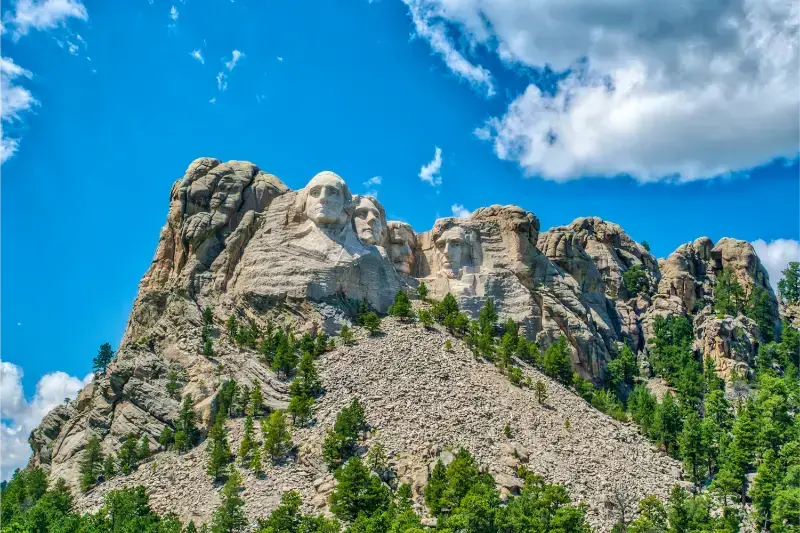
For a first Black Hills trip, Mount Rushmore is worth visiting even if you are skeptical of very famous landmarks. The scale, granite setting and design history make more sense in person than from the highway. The museum and sculptor’s studio also add context that a quick roadside photo cannot provide.
The site does not need a full day. That is the key planning advantage. Combine it with Iron Mountain Road, Keystone or another nearby attraction rather than stretching the memorial into an eight-hour block. Travelers who arrive early can often complete the core visit before the busiest part of the day and use the rest of the daylight for the Black Hills.
What to do — and how to prioritize it
Walk the Avenue of Flags slowly
The approach frames the sculpture deliberately and provides one of the memorial’s most recognizable perspectives. It is tempting to rush straight to the main terrace; instead, use the avenue as the transition from parking and let the scale build. Early morning usually feels calmer.
Use the visitor center before or after the main view
The Lincoln Borglum Visitor Center and museum exhibits explain design, carving methods and the people involved in the project. This context is valuable because the finished image is so familiar that visitors can otherwise leave without understanding how the work was actually created.
Walk the Presidential Trail if mobility and weather allow
The trail brings you closer to the mountain and changes the viewing angles. It includes stairs and elevation changes, so it is not merely an extension of the main terrace. If heat, ice or mobility makes the loop uncomfortable, the central viewpoints still deliver the essential experience.
Check the Sculptor’s Studio schedule
The studio helps connect models and carving plans to what you see on the mountain. Seasonal hours and programs can change, so treat it as a bonus that improves a visit rather than a guaranteed stop at any hour of the year.
Decide in advance whether the evening program matters
The lighting program creates a different atmosphere but changes the structure of your day. If you visit early and want to return at night, remember that the parking ticket for a non-commercial vehicle is generally valid for re-entry for a longer period, but verify current parking rules. If you only have one window, choose daylight for the best overall interpretive access.
How much time do you really need?
Two hours is enough for the main terrace, visitor-center exhibits and a focused visit. Three hours gives the Presidential Trail and more breathing room. Add extra time for meals, seasonal programs or crowded summer periods. There is little benefit in arriving with a full day blocked out unless the memorial is part of a very slow travel style.
If you plan the evening lighting program, consider a split visit: morning for trails and exhibits, evening for atmosphere. This works best if you are staying in Keystone or nearby. From Rapid City or Custer, decide whether the extra round trip is worth it before promising yourself two visits in one day.
Where to stay and how to choose the right base
Compare available accommodation for your dates, budget and preferred location before you finalize your route.
Keystone is the closest convenient base and makes early or late visits easy. Rapid City provides more dining and services, while Hill City and Custer can be better for travelers concentrating on the southern Black Hills. The best base depends on the other two attractions you plan to visit, not on Mount Rushmore alone.
If the memorial is your first stop the next morning, proximity has real value. If it is only one part of a multi-day park itinerary, staying slightly farther away can reduce total driving over the whole trip. Plot the full sequence—Mount Rushmore, Custer State Park, Crazy Horse, Deadwood—before booking.
Best time to go and what changes by season
Summer brings the fullest schedule and largest crowds. Early mornings are the simplest solution. Spring and fall can be excellent, but mountain weather changes rapidly and snow is possible outside the traditional winter months. NPS notes that March and April often receive substantial snow.
The memorial grounds remain accessible much of the year, though facilities use seasonal schedules and buildings close on Christmas Day. Winter can be quiet and beautiful, but ice and cold change the trail experience. Check current hours for the visitor center and studio instead of using summer times year-round.
How to fit this stop into a wider route
A particularly strong later route links Mount Rushmore with the northern side of Custer State Park via Iron Mountain Road. For this first block, plan the geography now but keep the internal link for Custer only after that article is live. The key principle is simple: do not drive from Rapid City to Mount Rushmore, back to Rapid City, then south again.
For a first visit before that later stop is available, the simplest pairing is Keystone plus a scenic drive and an easy afternoon. Mount Rushmore should be the anchor of a route, not an isolated round trip between two unrelated destinations.
Common planning mistakes
Do not confuse “no entrance fee” with “free visit.” Parking is concession-operated and carries a fee, and America the Beautiful passes do not cover it. Another mistake is arriving at noon in midsummer and concluding the site is inherently chaotic. Timing changes the experience dramatically.
Avoid oversized vehicle surprises. Parking lanes and tunnel routes elsewhere in the Black Hills have size constraints, and the most scenic roads near Custer State Park can have very small tunnels. If you are driving an RV or towing, plan the entire day’s roads, not just the Mount Rushmore garage.
A useful plan B
Fog, smoke or heavy precipitation can obscure the sculpture. If visibility is poor, use the museum and visitor-center time first and watch conditions before deciding whether to wait. Because the site is compact, it is often easier to return later the same day than to force a disappointing view.
Who will enjoy this stop most?
Mount Rushmore is strongest for first-time visitors, families and travelers interested in how monumental public art and national memory are constructed. The visit is accessible enough to fit different energy levels because the principal view does not require a strenuous hike.
Travelers seeking solitude should come early, late or outside peak summer. The memorial is not a wilderness experience, and that is not a flaw—it is a designed cultural site inside a mountain landscape. Enjoy it for what it is, then get your quieter outdoor time elsewhere in the Black Hills.
A final decision framework before you add this stop
Before locking this stop into the itinerary, ask three practical questions: does it add an experience that is genuinely different from the previous day, does it sit in the direction you are already traveling, and will you arrive with enough energy to enjoy it rather than simply photograph it? Western South Dakota is compact on a state map but slow on scenic roads, and fatigue is one of the main reasons travelers remember a famous place less vividly than expected. Protect the stops that are central to your interests and let secondary stops remain optional.
If the answer is yes to all three questions, protect the time and reduce something else rather than compressing the entire day. If only one answer is yes, keep the stop flexible. This approach is especially useful when weather, wildfire smoke, thunderstorms, road construction or wildlife delays alter a Black Hills day. A good itinerary is not the one that survives every disruption unchanged; it is the one that can change without losing its best experiences.
For families, also consider the rhythm of the previous day. Two long scenic-driving days in a row can be harder than one substantial hike followed by a compact town day. For photographers, protect early and late light but avoid sacrificing sleep every morning. For international travelers, remember that mountain roads, parking systems and ranger-led programs may take longer to understand than familiar local attractions. A little unused time is a feature, not a planning failure.
Practical details to verify shortly before travel
No reservation is generally needed for ordinary visits or the evening lighting program, but parking fees, seasonal hours and program times can change. Confirm the current NPS schedule and parking information shortly before travel, especially if the evening program is central to your day.
Official source: National Park Service — Mount Rushmore fees and parking.
Continue planning South Dakota
Start from the South Dakota travel guide and use the Rapid City guide to decide whether the city or a smaller Black Hills town is the better base.
Final planning advice
Mount Rushmore is easiest when you resist the urge to make it complicated. Arrive at a smart hour, understand the parking system, add the trail and museum if they interest you, then use the rest of the day for the landscape around the memorial.