

Jamestown is not one attraction with one ticket. Travelers often arrive expecting a single historic village and discover two separate experiences: the original archaeological site at Historic Jamestowne and the nearby Jamestown Settlement living-history museum. Both tell essential parts of Virginia's story, but they do it in different ways. Choosing the right combination can turn a confusing stop between Williamsburg and Yorktown into one of the most worthwhile days on the Historic Triangle.
The first decision is how much time you have. Visitors interested in archaeology, original landscapes and the evidence being uncovered today should give Historic Jamestowne priority. Families who want interpreters, reconstructed ships and a clearer introduction to early colonial life may find Jamestown Settlement easier to navigate. With a full day, however, seeing both provides a much more complete picture than rushing through either one.
Plan at a glance
| Planning point | Useful details |
|---|---|
| Best season | Spring and fall have milder conditions; summer is hot and humid |
| Time needed | A full day for both sites; half a day if choosing one |
| Location | Jamestown, Virginia, USA |
| Before you go | Check current hours, closures and tickets on the official websites |
Know the difference before buying tickets
Historic Jamestowne occupies the actual place where English settlers established the permanent colony in 1607. Its archaeological excavations, memorial church, James Fort remains and Archaearium museum deal with original evidence and changing interpretations. Archaeologists have worked to locate buildings, fortifications and objects that connect written accounts to the physical record. The site is especially rewarding when you slow down enough to read what a trench, foundation or artifact tells you rather than expecting fully reconstructed streets.
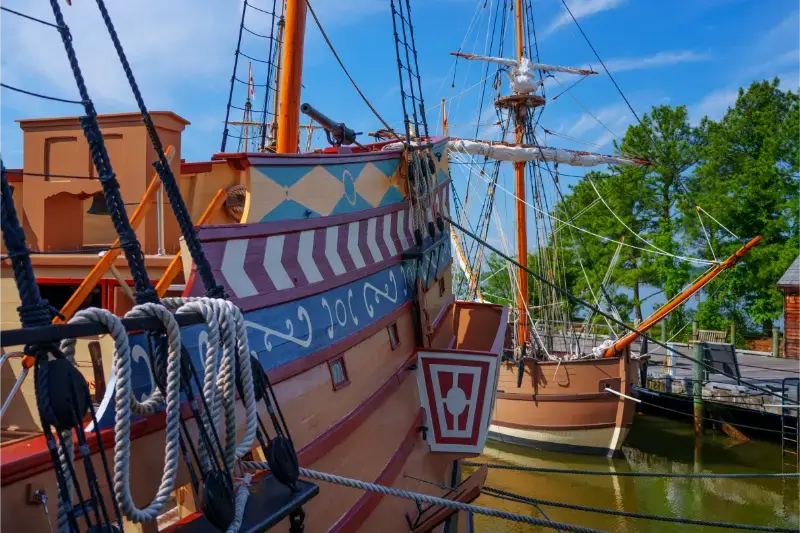
Jamestown Settlement is a different institution, operated by the Jamestown-Yorktown Foundation. Inside the museum, films and galleries provide broader context; outside, recreated ships, a fort and an Indigenous town help explain daily activities and encounters among the peoples whose lives shaped early Virginia. Demonstrations and interpreters are a major part of the appeal. The reconstructed setting is educational, but it should not be mistaken for the precise location of the original fort.
Historic Jamestowne: what to look for
Start at the visitor center, then follow the route toward the original fort area. The point is not to collect landmarks as fast as possible. Look at the relationship between the James River, the defensive position and the settlement ground. Changes to the shoreline and the long history of excavations help explain why the location mattered and how interpretations evolved. Ranger programs and archaeological talks can add context that static signs cannot provide.
Make time for the Archaearium if it is open during your visit. Finds recovered from the site illuminate food, trade, medicine, military life and the personal costs of colonization. It is worth treating the objects as evidence rather than curiosities. Ask what can be established with confidence and what remains uncertain. The Memorial Church and the site of the fort are useful stops, but the strength of Historic Jamestowne lies in the connections among those places.
Jamestown Settlement: ships, galleries and living history
The indoor exhibitions are a useful starting point, particularly in hot weather or when visiting with children. They introduce the peoples, ambitions and conflicts that converged in seventeenth-century Virginia. Take time with exhibits on Powhatan societies and the arrival of Africans; a visit focused solely on English settlement misses crucial history. The museum can help visitors understand how different perspectives alter the telling of familiar events.
Outside, recreated ships illustrate the cramped spaces and practical challenges of transatlantic travel. The re-created fort and Paspahegh town invite questions about shelter, work, food and cultural contact. Demonstrations depend on the day and staffing, so do not build an itinerary around a guaranteed activity. A few well-chosen conversations with interpreters will usually give a family more value than racing through every demonstration.
Ticket combinations: the detail that surprises visitors
Historic Jamestowne is jointly managed by the National Park Service and Preservation Virginia. That division has real implications for admission. The National Park Service pass is needed to access the island, and the Preservation Virginia areas require additional admission unless covered by an applicable ticket. The official Historic Jamestowne ticket page spells out the difference. A national parks pass does not automatically cover every part of the archaeological site.
Jamestown Settlement has its own admissions system and is not included simply because you paid to enter Historic Jamestowne. Some museum combinations are offered with the American Revolution Museum at Yorktown, which is also distinct from the federal Yorktown Battlefield. Compare precisely which institution each combination covers. Before paying, decide whether you have time to make full use of it; buying the biggest package is rarely a savings when you can visit only one site properly.
How to spend one good day at Jamestown
Arrive around opening time at Historic Jamestowne, when outdoor walking is often easier and the archaeological landscape feels less hurried. Allow two to three hours for the visitor center, fort site, church area and museum, more if a ranger or archaeologist program catches your interest. Bring water and protect yourself from sun exposure: shade is uneven, and Virginia humidity can be draining even on a day that does not look particularly hot.
After lunch, spend the afternoon at Jamestown Settlement. Begin indoors to reset before heading to the outdoor re-creations. If you have young children, avoid trying to read every panel. Pick a few questions—how people traveled, what people ate, who lived here before the English arrived—and follow them through the galleries and outdoor sites. If your interests run strongly toward living history, reverse the order and give the museum your freshest hours.
Getting there and connecting the Historic Triangle
Jamestown sits southwest of Williamsburg and can be reached by road; many visitors pair the area with Colonial Williamsburg on a separate day. The Colonial Parkway historically connects Jamestown and Yorktown, but maintenance and construction can affect sections of the route. Check current park notices rather than following an old scenic-drive itinerary without checking for detours. A car is useful for moving between these dispersed sites.
If you have a second day, devote it to Williamsburg or Yorktown instead of squeezing all three into one afternoon. Williamsburg concentrates on an eighteenth-century town, while Jamestown explores an earlier settlement and the wider consequences of colonization. Yorktown adds the Revolutionary War's final major campaign. These are connected stories, not interchangeable stops, and spacing them out helps travelers appreciate the different periods.
Visiting with children, accessibility and weather
Jamestown Settlement is often the simpler first stop with young children because the recreated environments are concrete and the indoor galleries offer a break from heat or rain. Historic Jamestowne can still be engaging: give children the job of spotting the river, earthworks and evidence of the fort, then use a short ranger presentation to fill in the story. Bring snacks and leave extra time between the two sites rather than planning a rigid minute-by-minute day.
Historic Jamestowne contains outdoor routes with changing surfaces, while Jamestown Settlement combines indoor museum access with paths to exterior exhibits. Visitors who need step-free access should check each institution's current accessibility information, since a single statement about "Jamestown" is not enough. Storms, extreme heat and special events can change the experience; review both institutions' calendars separately on the morning of a visit.
Where to stay and when to go
Compare available accommodation for your dates, budget and preferred location before you finalize your route.
Williamsburg is the most convenient base for travelers spending several days exploring Jamestown, Colonial Williamsburg and Yorktown. Look beyond the headline nightly rate: breakfast, parking and driving time can change the value of an otherwise attractive hotel. Yorktown is a quieter alternative for a trip weighted toward the battlefield and waterfront; some visitors prefer it after long museum days. Staying directly in the immediate Jamestown area usually offers fewer choices.
Spring and fall generally provide more comfortable walking than the height of summer, while summer brings long daylight hours and family schedules but also humidity and crowds. Winter can be rewarding for quiet indoor exhibits, provided you check seasonal demonstrations and holiday closures. Whatever the month, choose a visit plan built around one or two meaningful experiences rather than trying to turn three centuries of history into a checklist.
The history deserves careful attention
Jamestown is more than a story about ships and colonial survival. The settlement existed within an Indigenous world with its own political relationships, economies and communities. Colonization brought displacement, warfare, disease and lasting changes. The first documented arrival of captive Africans to English Virginia in 1619 also forms part of this history, though historians distinguish the complex status of individuals in the early period from the later legal system of hereditary slavery.
A responsible visit makes room for those dimensions without reducing Indigenous and African lives to background for an English story. Read the exhibits that challenge assumptions, and notice where evidence is contested or incomplete. The strongest museums encourage questions rather than offering a neat heroic narrative. Visitors willing to take that approach usually leave with a richer understanding of how the early colony influenced the country that followed.
Allow room for quiet observation rather than rushing onward
One of Jamestown's best opportunities comes when you stop asking which attraction is next and pay attention to the relationship between place and evidence. Stand at the river's edge, consider how access to food and fresh water influenced daily decisions, and then look back toward the excavated settlement. A small archaeological object can tell a more precise story than a dramatic reconstruction if you know the question it helps answer. That is why a ranger conversation or archaeology presentation can be worth rearranging your afternoon around.
If time is limited, resist the temptation to squeeze both sites into a single ninety-minute visit. Choose the setting that matches your interests and return for the other on a different day. The site is part of a larger Historic Triangle, not an isolated attraction that must be finished in one pass.
Map and location
Book accommodation and practical services
Frequently asked questions
Is Historic Jamestowne the same as Jamestown Settlement?
No. Historic Jamestowne is the original archaeological site; Jamestown Settlement is a separate living-history museum with re-created settings.
Do I need two tickets at Historic Jamestowne?
Access involves the National Park Service and Preservation Virginia. Check the official ticket breakdown for the parts you intend to visit.
Can I visit both Jamestown attractions in one day?
Yes. Plan a full day, allow time for lunch and do not expect to cover every exhibit or demonstration.
Is there a combined ticket with Yorktown?
Some museum combinations cover Jamestown Settlement and the American Revolution Museum at Yorktown, not necessarily NPS Yorktown Battlefield.
Where should I stay?
Williamsburg offers the broadest range of hotels and works well for multi-day Historic Triangle itineraries.
Official resources
For more ideas, explore Virginia destination guide, historic attractions across America, U.S. trip-planning advice.