

Everglades National Park is not a single swamp you drive into, photograph an alligator, and leave. It is a vast subtropical wilderness of sawgrass marsh, mangrove coast, hardwood hammocks, pinelands and shallow estuaries spread across the southern tip of Florida. The most important planning fact is also the one many first-time visitors miss: the park has several major access areas, and they are not connected to one another by an internal scenic road. Choosing the right entrance can save hours and completely change the day.
This guide explains how to choose between Shark Valley, the Homestead–Royal Palm–Flamingo corridor and the Gulf Coast side, when wildlife viewing is best, whether an airboat ride is actually inside the national park, and how to combine the Everglades with Miami or the Florida Keys. For statewide planning, start with our Florida Travel Guide and best things to do in Florida guide.
Everglades National Park at a glance
| Question | Practical answer |
|---|---|
| How many days? | One full day for a first taste; two days if you want two different park areas. |
| Best season? | Dry season is usually the easiest for wildlife viewing, lower humidity and fewer mosquitoes. |
| Do you need a car? | Yes for most independent visits; the entrances are widely separated. |
| Best first-time area? | Royal Palm + Flamingo for ecosystem variety; Shark Valley for cycling/tram and wildlife density. |
| Airboats? | Popular around the Everglades region, but not the defining experience inside the national park itself. |
| Can you do it from Miami? | Yes, but choose one park area rather than trying to cover everything in a rushed loop. |
First decision: which Everglades entrance should you use?
Shark Valley: easiest wildlife-focused day from Miami
Shark Valley is the most straightforward option for travelers who want an accessible first encounter with the Everglades landscape. The famous paved loop can be explored by bicycle or tram, and the open marsh environment makes wildlife surprisingly visible in the dry season. Alligators can appear close to the path, but that does not make them tame: keep the required distance, never block an animal’s route, and do not interpret stillness as permission to approach.
Shark Valley works especially well when you have only half a day or when the group includes travelers who prefer a structured outing. It does not, however, show the full ecological range of the park. If mangroves, Flamingo, coastal waters and a deeper sense of scale matter to you, use the southern entrance instead.
Homestead, Royal Palm and Flamingo: the best all-round first visit
The main southern route enters near Homestead and passes the Ernest F. Coe Visitor Center before reaching Royal Palm, pinelands, ponds and eventually Flamingo at the edge of Florida Bay. This corridor is the best choice for travelers who want to understand that the Everglades is a mosaic of habitats rather than endless sawgrass. Short boardwalks and roadside stops create an easy progression from freshwater marsh to mangrove coast.
The drive to Flamingo is longer than it appears on a map because you will stop repeatedly. Treat Flamingo as a destination rather than a quick turnaround point. Boat tours, paddling and broad views over Florida Bay make it worthwhile, while the return drive can be timed for softer late-afternoon light.
Gulf Coast / Everglades City: the mangrove-water perspective
The western side near Everglades City is different again. Here the experience is shaped by the Ten Thousand Islands, tidal waterways and boat-based access. This side pairs naturally with Naples, Marco Island and a southwest Florida road trip. It is less convenient as a same-day add-on from Miami, but excellent when your route already follows the Gulf Coast.
Dry season vs wet season: this choice changes the entire visit
The National Park Service describes two broad seasons. Dry season generally brings cooler, less humid conditions, lower water levels, fewer insects and stronger concentrations of wildlife around remaining water. It is also the busiest period. Wet season brings heat, humidity, frequent afternoon thunderstorms, higher water and often intense mosquito activity; wildlife can be more dispersed and some ranger programming is reduced.
That does not make summer impossible. Wet-season visitors can see a lush, water-filled landscape with dramatic skies and fewer crowds. The strategy simply changes: start very early, carry serious insect protection, plan shorter outdoor walks, monitor lightning, and keep an indoor or driving-based backup. Download park maps before entering areas with weak cellular coverage.
What wildlife can you realistically expect to see?
Alligators are common, especially in freshwater areas, but the park is much more than an alligator-viewing destination. Wading birds, turtles, anhingas, herons, egrets, hawks and vultures are among the animals visitors frequently notice. Manatees and crocodiles may be seen around the southern coastal zone, while elusive species such as the Florida panther should never be treated as a realistic checklist item.
The best wildlife strategy is patience rather than mileage. Spend ten quiet minutes at a productive water edge instead of racing from boardwalk to boardwalk. Early morning and later afternoon often produce better light and animal activity, while midday heat can flatten both.
Airboat rides: what first-time visitors should know
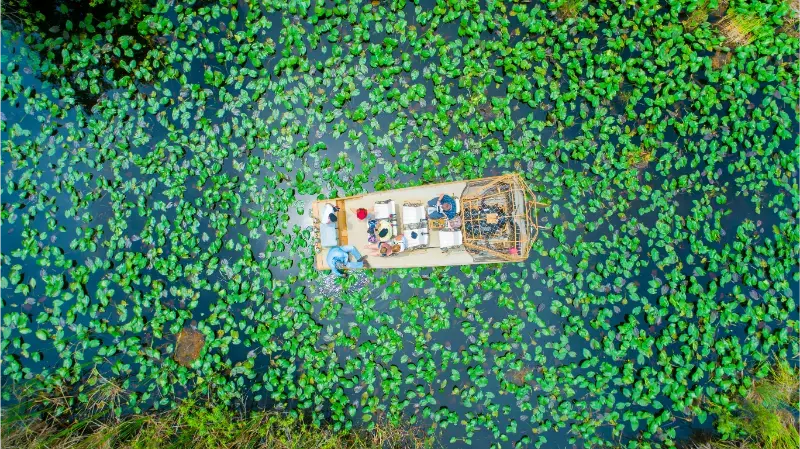
Airboats are strongly associated with the Everglades, but the national park itself protects sensitive areas where airboat access is restricted. Commercial airboat operators generally work in surrounding Everglades ecosystems outside the core park. That can still be an enjoyable regional experience, but understand what you are booking. If your goal is to learn the national park, make time for a park entrance, boardwalk, tram, bike route, paddle or ranger activity in addition to any commercial airboat tour.
Best easy walks and short stops for a first visit
- Anhinga Trail: one of the classic short walks near Royal Palm, especially productive in the dry season.
- Gumbo Limbo Trail: a short contrast to the open marsh, passing through a shaded hardwood hammock.
- Pa-hay-okee overlook: a quick elevated view across the river-of-grass landscape.
- Mahogany Hammock: useful for seeing how small rises in elevation create different plant communities.
- Shark Valley loop: best by bike or tram for travelers who want distance without a backcountry hike.
A one-day Everglades itinerary from Miami
- Leave Miami early enough to reach the Homestead entrance near opening time.
- Stop at Ernest F. Coe Visitor Center for current conditions, ranger information and orientation.
- Walk Anhinga Trail and Gumbo Limbo Trail at Royal Palm before the day becomes hotter.
- Drive south slowly, stopping at selected overlooks rather than every pullout.
- Reach Flamingo for lunch, waterfront views and a boat or paddle experience if booked.
- Return before dark unless you are intentionally staying for sunset and are comfortable with wildlife on the road.
If Shark Valley is your priority, do not try to bolt it onto this exact route. The drive between entrances requires leaving the park system and using public roads. A Shark Valley day should be designed around Shark Valley, perhaps paired with a Miccosukee cultural stop or another western Miami-area activity.
Can you visit the Everglades on the way to the Florida Keys?
Yes, but only if you are disciplined about geography. The southern entrance near Homestead works naturally before driving to Key Largo. A morning at Royal Palm followed by an afternoon continuation to the Upper Keys can be excellent. Trying to add Shark Valley, Flamingo and Key West on the same day is not. Use our Florida Keys Travel Guide and upcoming Miami to Key West road trip for the logical sequence.
Do you need a guided tour?
No for a basic first visit, but the right guide can reveal much more than an independent drive. Birding guides, naturalists, kayak guides and ranger programs can explain water flow, invasive species, fire ecology and animal behavior that are easy to miss. If you have only one day and ecology is your main interest, paying for expertise often adds more value than paying for another attraction later in the trip.
Everglades with kids
Children often respond better to short, wildlife-rich walks than to long drives. Build the day around one strong animal-viewing period, one picnic or food stop and one boat/tram/paddle activity. Bring more water than you think you need and treat mosquito protection as essential equipment, not a minor comfort item. Never allow children to approach wildlife for a photo, even when other visitors are doing it.
Heat, storms, insects and safety
- Carry water and electrolytes; shade can be limited on exposed boardwalks.
- Use sun protection even on hazy days.
- In wet season, mosquitoes can be intense—repellent and protective clothing matter.
- Lightning is a serious Florida hazard; move to shelter when storms approach.
- Stay on designated paths and platforms around wildlife.
- Never feed alligators, crocodiles or birds; feeding changes animal behavior and creates danger.
Where to stay for an Everglades trip
Compare available accommodation for your dates, budget and preferred location before you finalize your route.
Miami works for Shark Valley and can work for the southern entrance, but Homestead or Florida City reduce morning driving for Royal Palm and Flamingo. Everglades City is the natural base for the Gulf Coast side. If the park is part of a longer itinerary, choose the hotel based on the next day’s direction: Homestead before the Keys, Everglades City before Naples, or Miami when the park is a day trip between city days.
Compare accommodation: compare hotels and other stays on Booking.com.
Mistakes that make the Everglades feel disappointing
- Arriving at noon in summer and concluding there is ‘nothing to see.’
- Assuming all park entrances connect internally.
- Treating an airboat ride outside the park as a complete Everglades National Park visit.
- Trying to see Shark Valley, Flamingo and the Gulf Coast in one day.
- Leaving binoculars behind if birdlife interests you.
- Standing too close to alligators because they appear inactive.
- Ignoring mosquitoes, heat or thunderstorm forecasts.
Useful official resources
- Everglades National Park — Plan Your Visit
- Everglades National Park — Basic Information
- Everglades National Park — Weather
- Everglades National Park — Current Conditions
Is Everglades National Park worth it?
Yes, especially if you approach it as a landscape to understand rather than an attraction to consume. The park rewards slow observation: water levels, birds, subtle elevation changes, mangrove roots, distant storms and the realization that South Florida’s cities exist beside one of North America’s most unusual ecosystems. For many travelers, the Everglades becomes more memorable precisely because it looks nothing like the postcard version of Florida.