

Destinations › Southwest › Arizona › Saguaro National Park & Tucson
Saguaro National Park is not one compact park entrance—it is two separate districts on opposite sides of Tucson. The Tucson Mountain District (West) has dense stands of saguaros and a rougher scenic loop; the Rincon Mountain District (East) has a paved loop, longer trail network and elevation that rises into mountain ecosystems. Driving between them can take roughly 45–60 minutes, so one day should not be planned as constant back-and-forth.
Tucson is the natural base and deserves part of the trip itself. Sonoran food, desert museums and neighborhoods turn a park visit into a broader southern Arizona experience.
At a glance
| Question | Best answer |
| Ideal stay | 2–3 nights in Tucson |
| West district | Dense saguaro forest, Bajada Loop, sunset-friendly |
| East district | Paved Cactus Forest Loop, longer hiking network |
| Drive between districts | Roughly 45–60 minutes |
| Best season | November–March for easiest hiking |
How to visit Saguaro National Park and Tucson
Saguaro West: Tucson Mountain District
The west side contains a younger but denser saguaro forest and the unpaved Bajada Loop Drive. The NPS getting-around guide describes the scenic loop as a graded dirt route with pullouts, picnic areas and trailheads. It is excellent for a half day of short walks and photography.
Pair the district with the Arizona-Sonora Desert Museum or Gates Pass area for a geographically efficient day.
Saguaro East: Rincon Mountain District
The east side has the paved 8-mile Cactus Forest Scenic Loop Drive and access to a much larger trail network. It feels less like a quick scenic stop and more like a gateway into the Rincon Mountains, where ecosystems change as elevation increases.
The loop road has limited space for large vehicles, so RV travelers should study NPS restrictions carefully.
Choose West vs East by trip style
If you have only half a day and want classic dense cactus scenery, West is often the simpler choice. If you want paved scenic driving and more hiking options, East is compelling. With two days, visit both and stop treating the decision as a competition.
Sunrise and sunset can change the answer: choose the district that minimizes driving in darkness after your planned viewpoint.
Short hikes for first-time visitors
Both districts offer short walks that reveal desert ecology without committing to all-day mileage. In hot weather, a modest sunrise trail can be more rewarding than a famous summit attempted too late. Ask rangers for the best current option because trail exposure, water and seasonal conditions matter.
The desert is visually open but not forgiving; carry water even on short routes.
Longer hiking and elevation
The Rincon Mountains rise far above the valley floor, allowing ambitious hikers to move from desert scrub into woodland and high-elevation environments. These are not casual urban hikes. Distances, water availability and weather can differ dramatically from Tucson below.
Backcountry camping requires planning and reservations; do not improvise an overnight route.
Current 2026 park conditions
As of the NPS 2026 conditions page, roads and picnic areas in the east district are open, while the west side has a permanent vehicle closure on part of Golden Gate Road that has been converted to a multi-use trail. Visitor center hours also change seasonally. Always check current Saguaro conditions before driving out.
Summer temperatures routinely reach dangerous levels, making early or late-day visits essential.
Tucson beyond the park
Tucson adds depth through food, history and desert culture. Combine the park with the Arizona-Sonora Desert Museum, Mission San Xavier del Bac, a Sonoran meal and one neighborhood or downtown block. This makes the trip feel distinct from Phoenix rather than another desert-city stop.
The city is also a practical base for rest between early hiking windows.
Wildflowers, saguaro blooms and seasonal change
Late winter and spring can bring wildflowers, while saguaros usually bloom later in spring. Conditions vary with rainfall, so bloom timing should be treated as a bonus rather than a guaranteed event. Summer monsoon clouds can be dramatic but bring lightning and flash-flood risk.
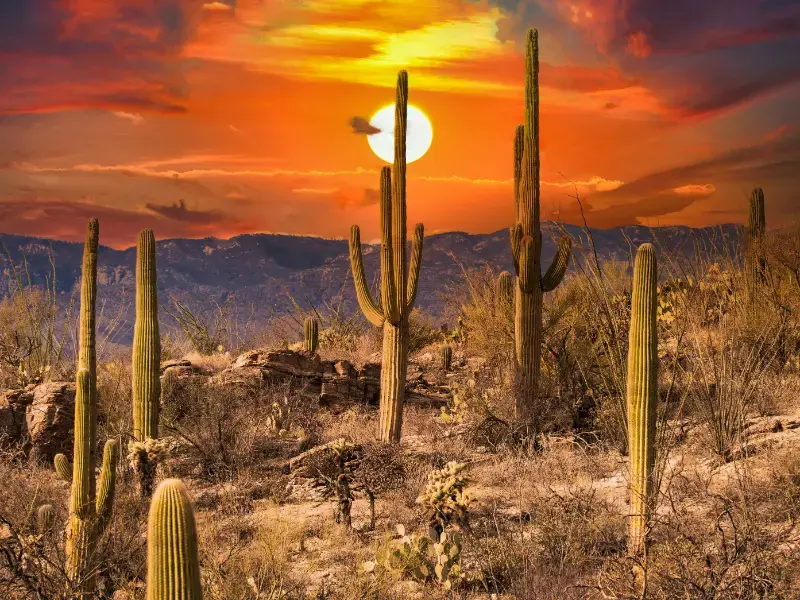
Never leave roads or trails to trample vegetation for photographs.
How to plan the trip without overpacking the day
Plan each district as a half-day geographic block. Do West with west-side Tucson attractions and East with east-side neighborhoods or a relaxed meal. This avoids spending the best cool hours crossing the city.
If temperatures are high, shorten the hiking plan before you arrive. Desert safety is easier when it is built into the itinerary, not decided after someone begins to feel sick.
Best time to go
November through March is the most comfortable hiking season and also the busiest. Spring adds blooming plants and warmer days. Summer demands sunrise starts and conservative mileage; monsoon storms can make exposed ridges and washes dangerous.
Winter nights can be cold even when afternoons are pleasant. Carry layers for sunrise, particularly if you are coming from a warm Phoenix hotel and assume southern Arizona is always hot.
Getting there and getting around
Tucson is the practical base, with the two park districts on opposite sides of the metro. A car is strongly recommended. Do not type only “Saguaro National Park” into navigation; NPS specifically recommends using the physical address for the district you intend to visit because map apps can confuse east and west.
Large vehicles face loop-road restrictions and limited parking. RV travelers should review the NPS vehicle guidance before entering either district.
Where to stay and how many nights
Stay in Tucson for two or three nights. Downtown/central locations work for food and culture, while east- or west-side lodging can reduce the drive to a specific park district.
If the park is the priority, choose the side that matches your first-morning district so you can be on the trail before heat and traffic build.
Compare accommodation: compare hotels and other stays on Booking.com.
A simple first-time itinerary
- Day 1: Tucson arrival + food/culture block
- Day 2: Saguaro West at sunrise + Arizona-Sonora Desert Museum + Gates Pass sunset
- Day 3: Saguaro East scenic loop/short hike + continue toward Phoenix
For one day only, choose one district and add one Tucson experience rather than spending the middle of the day commuting across the city.
Common mistakes to avoid
- Assuming the east and west districts are adjacent
- Searching generic park name in navigation
- Hiking midday in summer
- Driving an RV onto loops without checking restrictions
- Skipping Tucson and treating the park as a Phoenix day trip
The two-district structure is the key planning fact. Once you respect the geography, Saguaro becomes easy to organize.
Build this into a wider Arizona trip
Saguaro/Tucson adds a completely different desert ecosystem to a trip that includes Phoenix, Sedona and Grand Canyon. It is particularly worthwhile on a 10–14 day Arizona route.
Useful official resources
More Arizona planning
- Arizona Travel Guide
- Best Things to Do in Arizona
- Arizona Road Trip: 10–14 Days
- Best Time to Visit Arizona
- Phoenix Travel Guide
- 7 Days in Arizona
Extra practical advice
One useful way to improve the itinerary is to protect the first hour of the day. In Arizona, the early window often has cooler temperatures, softer light, easier parking and more wildlife activity. Use that hour for the experience that would be hardest to repeat later, then let breakfast, shopping or a scenic drive absorb any delays. This simple habit also reduces the temptation to rush when a trail, tour or road takes longer than expected.
Build a backup that is genuinely different from the main plan. If the primary activity is an exposed hike, the backup should not be another exposed hike nearby. Choose an indoor museum, a shaded creek, a scenic drive, a pool block or a town experience. Arizona weather can vary sharply by elevation, and a good backup lets you respond to heat, storms or wind without feeling that the day has been lost.
For road trips, measure difficulty by the entire day rather than by drive time alone. A two-hour transfer after a sunrise hike, restaurant stop and sunset viewpoint can feel harder than a four-hour morning drive with no commitments. Keep arrival evenings light, avoid nonrefundable dinner reservations after long desert legs and refuel before remote highways. The best road-trip days end with enough energy to enjoy where you arrived.
Photography can quietly consume a trip if every overlook becomes a production. Pick one or two places where light matters, then allow the rest of the day to be experienced without chasing perfect conditions. This is particularly useful in the Southwest, where cloud cover, dust, monsoon storms and seasonal sun angles can make the landscape look completely different from reference photos. A flexible traveler usually comes home with better memories and often better images.
One useful way to improve the itinerary is to protect the first hour of the day. In Arizona, the early window often has cooler temperatures, softer light, easier parking and more wildlife activity. Use that hour for the experience that would be hardest to repeat later, then let breakfast, shopping or a scenic drive absorb any delays. This simple habit also reduces the temptation to rush when a trail, tour or road takes longer than expected.
Looking for the right place to stay? Compare hotels and accommodation on Booking.com.