

Destinations › Northeast › New York › New York City › Best Views in New York City
The best New York view is not automatically the highest one. A great viewpoint depends on what you want inside the view: Empire State Building, Central Park, bridges, Lower Manhattan, sunset over the Hudson, a classic skyline from across the river, or simply a free place where you can sit for an hour.
For a first trip, choose one paid observation deck and add two or three free viewpoints. Pick Top of the Rock if you want the Empire State Building in your skyline, Edge for an outdoor west-side perspective, SUMMIT for an immersive experience, One World for Lower Manhattan, or the Empire State Building for the icon itself.
The major observation decks compared
| Viewpoint | Best feature | Main trade-off |
|---|---|---|
| Top of the Rock | Empire State Building + Central Park context | Popular sunset slots |
| Empire State Building | Classic open-air icon | You cannot see the ESB in your own skyline view |
| Edge | Outdoor platform + Hudson/downtown views | Far west; experience can feel attraction-heavy |
| SUMMIT One Vanderbilt | Immersive rooms + Midtown proximity | Mirrors/crowds can dominate if you want pure photography |
| One World Observatory | Highest Lower Manhattan perspective; weather-protected | Primarily indoor/enclosed viewing |
Top of the Rock: best classic Midtown composition
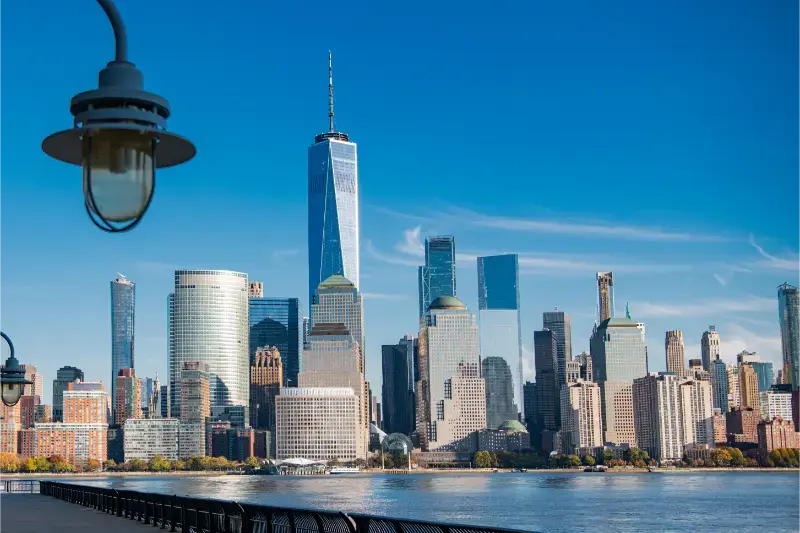
Top of the Rock’s advantage is simple: the Empire State Building is in front of you rather than underneath you. Looking south gives the Midtown-to-downtown axis; north gives Central Park, although new towers increasingly shape that view. Multiple levels provide different photographic options. If your mental image of a New York skyline includes the Empire State Building, this is often the most satisfying paid choice.
Empire State Building: best for the landmark experience
The Empire State Building is not merely a platform; the appeal is being inside one of the city’s defining structures. The drawback is obvious: the building itself cannot be part of your skyline photo. Choose it if architecture/history and the symbolic experience matter more than the “best composition.” Its central location makes it easy to pair with Koreatown, Herald Square, Madison Square and Midtown South.
Edge: best outdoor drama on the west side
Edge projects from 30 Hudson Yards and gives strong views south over the Hudson waterfront and downtown, plus north/upstate-facing perspectives. It is especially useful if your day already includes the High Line or Hudson Yards. The glass floor and angled glass walls add thrill elements, but photographers may prefer to focus on open views rather than the attraction features.
SUMMIT One Vanderbilt: best if the experience matters as much as the view
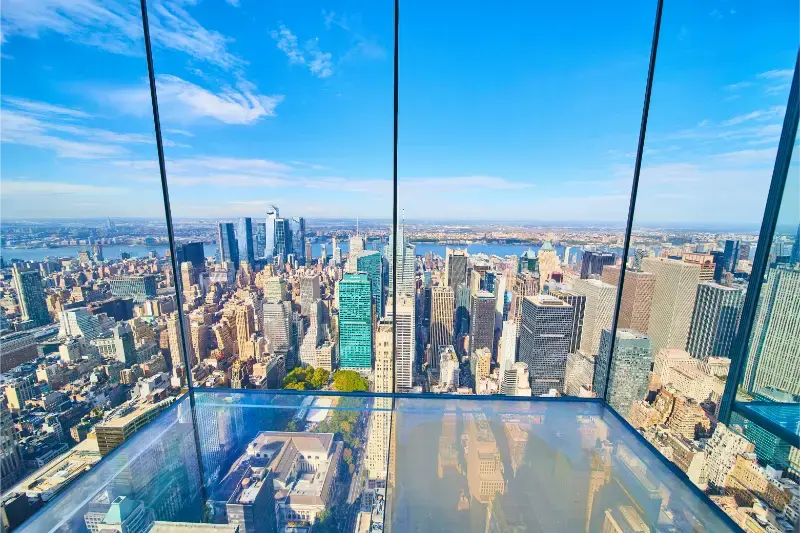
SUMMIT combines skyline views with reflective and immersive installations. It is beside Grand Central, making it exceptionally easy to fit into a Midtown route. Current posted hours can run late, with seasonal schedule changes and a regular Tuesday closure listed at the time of writing. Because reflective spaces are part of the visit, clothing, crowds and bright sun can affect the experience more than at a conventional deck.
One World Observatory: best Lower Manhattan overview
One World Observatory sits high above the World Trade Center and gives a different city geometry: harbor, Statue of Liberty, Brooklyn bridges, New Jersey and the dense downtown street pattern. It is enclosed, which is useful in cold or windy weather. The current schedule is generally 9 a.m.–9 p.m., but hours change seasonally. Pair it with the 9/11 Memorial, Oculus, Battery or Seaport.
Best free skyline views in Manhattan
- Pier 57 rooftop park: Hudson River and Lower Manhattan perspectives with no observation-deck ticket.
- Little Island / Hudson River Park: low-level but atmospheric river, sunset and west-side views.
- Roosevelt Island Tram: not free, but covered by normal transit-style fare and gives moving East River views; Roosevelt Island itself adds skyline angles.
- Central Park: Gapstow Bridge, Reservoir and Sheep Meadow frame skyscrapers through landscape rather than from above.
- High Line: urban canyon and west-side architecture rather than a postcard skyline.
Best free views from Brooklyn and Queens
- Brooklyn Heights Promenade: classic Lower Manhattan, harbor and bridge context.
- Brooklyn Bridge Park: multiple piers give changing angles toward Lower Manhattan and Brooklyn Bridge.
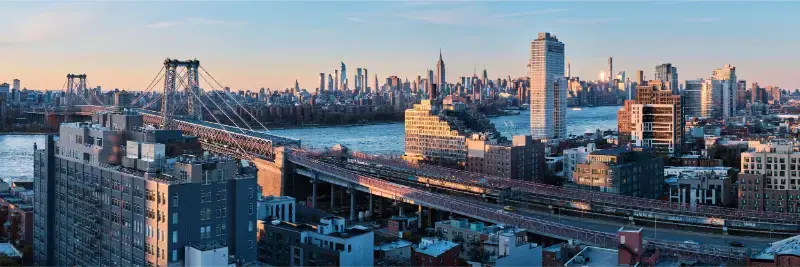
- DUMBO waterfront: Manhattan Bridge and East River compositions; best when combined with a neighborhood walk.
- Gantry Plaza State Park / Hunters Point South: excellent Midtown skyline across the East River, especially around blue hour.
- Sunset Park: elevated neighborhood perspective toward Manhattan and New York Harbor, less polished and more local.
Staten Island Ferry: the best free moving view
The Staten Island Ferry is free and gives harbor views that include the Statue of Liberty and Lower Manhattan. It is transportation, not a sightseeing cruise, so manage expectations: you do not stop beside Liberty Island, narration is not the point and commuters use the service. For a visitor, the value is the combination of zero ticket cost, open harbor and a changing skyline.
Sunset: when paying more may be worth it
Sunset slots are popular because one ticket can cover daylight, sunset and night. They can also cost more and feel crowded. A practical alternative is to choose a late-afternoon free waterfront view one day and visit a paid deck at night or morning on another. If weather is uncertain, flexible or refundable products matter more than chasing the perfect minute weeks in advance.
Photography strategy
Glass is the enemy of night photography: reflections from bright clothing, screens and interior lights can appear in images. Outdoor decks reduce that issue but bring wind and weather. Clean your phone lens before sunset, lower exposure slightly to preserve sky color and take fewer, more deliberate compositions. For skyline photography, the hour after sunset often produces more balanced building/sky brightness than full darkness.
Which view for families?
Choose the experience that requires the least extra travel on your day. Children can enjoy SUMMIT/Edge interactive features, but sensory-sensitive kids may prefer a more conventional deck. Strollers and accessibility policies vary. Free waterfront parks offer the easiest escape if a child is tired, which can make them a better “view” than a timed premium ticket.
Common viewpoint mistakes
- Booking three paid decks on a four-day trip.
- Choosing a deck without thinking about which landmark you want in the view.
- Paying for sunset on a day with a poor forecast when flexibility was available.
- Forgetting wind/temperature at outdoor decks.
- Ignoring free cross-river views that show Manhattan as a skyline rather than looking down on it.
- Using only full darkness and missing blue hour.
Frequently asked questions
Which observation deck has the best view of the Empire State Building?
Top of the Rock is the classic answer because the Empire State Building sits prominently to the south. SUMMIT also gives dramatic Midtown perspectives from farther east.
What is the best free view of Manhattan?
Brooklyn Heights Promenade/Brooklyn Bridge Park and Gantry Plaza/Hunters Point South are among the strongest because you see the skyline from across water. The Staten Island Ferry adds a moving harbor perspective.
How many observation decks should I visit?
For most first trips, one is enough. Two makes sense if they provide genuinely different geography or day/night experiences. More than two often has diminishing returns unless skyline architecture is a major interest.
Official planning sources
Continue planning New York City
One final planning principle applies especially well to Best Views in New York City: leave a little unused time. New York rewards curiosity, and the memorable part of a day is often the block you did not expect, the gallery you stayed in longer than planned, or the view that made you stop walking. A good plan protects those moments instead of eliminating them. Build around one or two anchors, understand the logistics, and keep enough flexibility to follow what interests you once you are there.
Weather is more important than the ticket brand
Low cloud, haze and rain can erase the advantage of an expensive deck. Visibility after a cold front may be spectacular; humid summer afternoons can look soft. If skyline photography is a priority, keep at least one free viewpoint flexible so you can move it to the clearest evening without paying a change fee.
Look in both directions
Visitors often face Manhattan and ignore what is behind them. From Brooklyn/Queens waterfronts, turn toward neighborhood architecture and bridges. From observation decks, look toward New Jersey, Queens, Brooklyn and the harbor as well as the Empire State Building. New York’s geography becomes much easier to understand once you see the city as islands and waterways rather than a list of landmarks.
A final practical layer
New York rewards plans that account for transition time. A map shows distance but not security lines, station stairs, crowded sidewalks, finding the correct entrance, waiting for elevators, restroom stops or the temptation to pause when something interesting appears. When estimating a transfer between two important reservations, add a buffer instead of assuming the fastest route will occur perfectly. This is especially important on weekends, during major events and in bad weather. If you arrive early, the extra time becomes a coffee, a short walk or a chance to look around; if you plan with no buffer, a small delay becomes stress.
Looking for the right place to stay? Compare hotels and accommodation on Booking.com.