

Destinations › Northeast › New York › New York City › The Metropolitan Museum of Art Guide
The Metropolitan Museum of Art is not a museum you “finish.” It is a collection of worlds under one roof, and the smartest first visit is selective. The goal is not to walk every gallery; it is to leave remembering specific rooms, objects and ideas instead of only remembering that your feet hurt.
Allow 3–4 hours for a first visit, choose three or four departments before entering, and arrive early or use the later Friday/Saturday hours. Current general admission is $30 for most non-New York adults; New York State residents and eligible NY/NJ/CT students have pay-what-you-wish options.
Met practical information for 2026
| Question | Practical answer |
|---|---|
| Where? | 1000 Fifth Avenue at 82nd Street, Upper East Side |
| Hours | Sun–Tue & Thu 10–5; Fri–Sat 10–9; closed Wednesday |
| Adult general admission | $30 for most non-NY visitors |
| How long? | 2 hours minimum; 3–5 hours is more satisfying |
| Nearest subway | 4/5/6 to 86th Street, then walk; crosstown buses also useful |
| Best pairing | Central Park, Upper East Side, Madison Avenue |
| Second Met location | The Met Cloisters in Fort Tryon Park |
What should a first-time visitor actually see?
The answer depends on your interests, but a balanced first visit can combine Egyptian Art, Greek and Roman Art, Arms and Armor, the American Wing and one major painting collection. That gives you changes of scale and medium rather than three hours of similar galleries. If European painting is your priority, spend more time there and cut something else. If architecture and interiors fascinate you, prioritize period rooms and the American Wing.
Egyptian Art and the Temple of Dendur

The Temple of Dendur is the obvious anchor, but the surrounding Egyptian galleries are what make the visit coherent. Move chronologically enough to understand how objects relate to daily life, religion and burial. The large glass-walled Sackler Wing gives the temple a sense of landscape that is especially memorable late in the day.
Arms and Armor
This is one of the museum’s best “reset” departments if you have been looking at paintings for an hour. Armor changes the visual rhythm and works well for visitors who think they are not museum people. Look beyond European suits of armor: the department spans multiple cultures and functions.
The American Wing
The American Wing combines painting, sculpture, decorative arts and reconstructed interiors. The Charles Engelhard Court is also a useful place to pause physically and visually. If your trip focuses on the United States, this section gives context that complements New York architecture and history outside the museum.
European paintings and sculpture
Do not treat famous artist names as a scavenger hunt. Pick a period or handful of galleries and spend time looking. The collection is large enough that works may move or galleries may close temporarily. Use the Met’s online collection and gallery-closure information shortly before your trip if a specific artwork is essential.
A 2-hour route for people with limited time
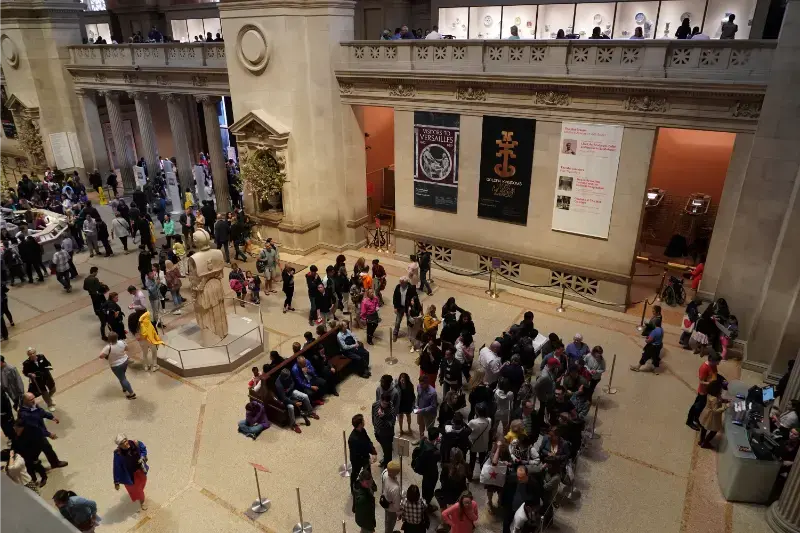
- Enter, get oriented in the Great Hall and go directly to your highest-priority department.
- Spend about 35–40 minutes in Egyptian Art, including the Temple of Dendur.
- Choose either Arms and Armor or Greek/Roman Art for another 25–30 minutes.
- Use 45 minutes for the painting/period collection that interests you most.
- Reserve 10–15 minutes for the American Wing court or one final favorite rather than sprinting to five more galleries.
A 4-hour route that feels much better
Start with one intellectually dense area while you are fresh, take a real break after roughly 90 minutes, then switch medium or era. A good rhythm is Egyptian Art → Greek/Roman or Islamic Art → break → Arms and Armor → American Wing → selected European/Asian galleries. The exact route matters less than alternating experiences and refusing to cross the entire building for one famous object every 15 minutes.
Should you visit The Met Cloisters too?
The Cloisters is in Fort Tryon Park in Upper Manhattan and focuses on medieval art and architecture. Current Met admission includes same-day entry to both Met locations. That does not mean you should automatically do both: travel time plus two museum visits can turn into a very long day. A better strategy is often to make the Cloisters the centerpiece of an Upper Manhattan half-day with Fort Tryon Park, then use your main Met visit on another day if your schedule allows.
The Met with children
The museum can work beautifully with children if you reduce the scope. Dinosaurs are at AMNH, not here; at The Met, children often respond well to armor, Egyptian objects, monumental sculpture, musical instruments and period rooms. Give them a mission—find three animals, compare two helmets, sketch one object—rather than asking them to follow adults through six painting galleries. Children 12 and under currently receive free admission.
2026 closure note
The museum is undergoing major long-term changes, and some galleries can close during renovation. In 2026, the Cantor Roof Garden and some modern/contemporary and ancient West Asian/Cypriot galleries have closures listed by the museum. Check the official “gallery closures” page before building a visit around a specific space. This is also why old blog itineraries should not be followed room-for-room.
Where to eat and when to take a break
A museum this large punishes the “we will eat after we finish” plan because you never finish. Break around the 90-minute mark. You can use museum cafés or leave after your visit for the Upper East Side. If you want to continue into Central Park, a snack before leaving the building can prevent a tired decision to abandon the park entirely.
Photography, bags and comfort
Expect security screening and changing gallery-specific photography rules. Travel light. Large luggage is a poor museum strategy even where storage exists. Wear the shoes you would choose for a long walking day: a four-hour museum visit can quietly produce several miles of indoor walking. A small water break and occasional seat will improve what you remember.
Common first-visit mistakes
- Trying to see “everything.”
- Using a greatest-hits list that sends you back and forth across the building.
- Arriving late on a short-closing day with a huge agenda.
- Ignoring Wednesday closure.
- Assuming the roof garden is always open.
- Skipping the map and losing 20 minutes finding a specific wing.
- Pairing a four-hour Met visit with another giant museum the same day.
Frequently asked questions
How long do you need at The Met?
Three to four hours is a strong first-visit target. Two hours can work with a focused route; a full day suits serious art lovers but requires breaks.
Is The Met pay what you wish?
Not for every visitor. Pay-what-you-wish eligibility is currently for New York State residents and students from New York, New Jersey and Connecticut who meet the museum’s requirements. Most other adult visitors pay general admission.
Can I visit The Met and Central Park together?
Yes. It is one of the city’s best combinations. Use the museum as the indoor anchor and then walk through the east side of Central Park toward Bethesda Terrace, the Ramble, Belvedere Castle or the west side depending on energy.
Official planning sources
Continue planning New York City
One final planning principle applies especially well to The Metropolitan Museum of Art Guide: leave a little unused time. New York rewards curiosity, and the memorable part of a day is often the block you did not expect, the gallery you stayed in longer than planned, or the view that made you stop walking. A good plan protects those moments instead of eliminating them. Build around one or two anchors, understand the logistics, and keep enough flexibility to follow what interests you once you are there.
How to use the Met map strategically
Before the visit, open the current floor plan and mark your first department, break point and final department. Inside, navigation is not always intuitive because wings connect through different floors. Planning three anchors prevents the common pattern of spending 20 minutes repeatedly asking how to reach the next masterpiece.
Friday and Saturday evenings
The later 9 p.m. closing on Friday and Saturday can transform the visit. Arrive in late afternoon, see several departments, take a break and continue as daytime crowds thin. It also pairs well with Central Park earlier in the day. Check current gallery hours because individual spaces can close before the building itself.
A final practical layer
New York rewards plans that account for transition time. A map shows distance but not security lines, station stairs, crowded sidewalks, finding the correct entrance, waiting for elevators, restroom stops or the temptation to pause when something interesting appears. When estimating a transfer between two important reservations, add a buffer instead of assuming the fastest route will occur perfectly. This is especially important on weekends, during major events and in bad weather. If you arrive early, the extra time becomes a coffee, a short walk or a chance to look around; if you plan with no buffer, a small delay becomes stress.
Looking for the right place to stay? Compare hotels and accommodation on Booking.com.